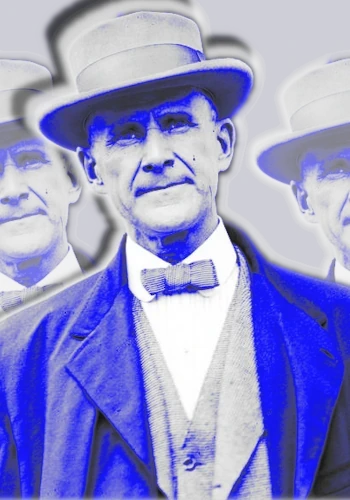
Eugene V. Debs
photo credit:
Harris & Ewing. "Eugene V. Debs" 1912. hosted by the Library of Congress' Prints and Photographs Division. [ID hec.01584]Public Domain: PD-US "No known restrictions"
hominidmedia:
[ Soo Line Events (1894) ][ E.V. Debs #4 ]
other:
Ray Ginger was dismissed from Harvard in 1954 for refusing to denounce Communist Party. According to his ex-wife in The Chronicle of Higher Education (13 April 2001)--this dismissal haunted Ginger who "drank himself to death." Harvard apologized in 2001. Ginger doesnt sensationalize Debs' alcohol use and childless marriage instead the biography is humanizing. Debs is constantly returning to Terre Haute in ill physical and psychological health related to his relentless campaign lifestyle. Two lasting impressions are the paint scraper that he kept from his first job on the rails and the volume of literature he produced.
Salvatore credit's Debs small town upbringing in his version of socialism. For instance, Debs first work experiences for the Hulman's was a kind of frontier bourgeoisie patronage. Here there was less conflict between capital and labor--instead, masculinity and social harmony promoted industrial development. A stunted industrial development in Debs' native Terre Haute also informed his understanding of capitalist speculation. Debs' fluid personal narrative impacts his words and deeds. A clear example is his laboring class background. While he did come up as a locomotive worker and unionist he was also a native born upwardly mobile small town American. Debs downplayed some social aspects of his childhood and marriage and emphasized his time working on the rails.
Chace's version of Debs during the 1912 election an absolutist and ideologue. He cites Salvatore's discussion on masculinity and labor. The ARU was a more inclusive, albeit racially segregated union. The Pullman Strike violence came against Deb's wishes but he couldn't overcome the loss of discipline and agents provocateur. Debs was arrested with others and charged with conspiracy to violate the injunction. Gompers and the AFL refused sympathy strikes and further charges of conspiracy. Cook County jail was gross. Debs had a dog to keep the rats at bay. Woodstock jail was nicer. The time at Cook County following Pullman is where Chace puts Debs' transformation from partisan Democrat to disaffected radical. Debs still was housed in the Woodstock jail during this transformation--this is another middle class 'luxury.' This is where Victor Berger was allowed to visit and brought him the famed copy of Kapital. Chace's Debs was "bored with Marxist theory" and turned to bourgeoisie politics. Populists and Greenbacks were popular outsider politics of the time. Debs participated in these before founding the SDP at an ARU convention in 1897. He tried to stay to the left of Berger and Hillquit the "right wing of the Socialist movement" who were only viable because of Debs national profile. He ran again for this party, renamed Socialist Party of America, in 1904. Getting four times more votes. He tried to Americanize the class struggle using Lincoln and the Declaration of Independence. He embraced middle class bureaucracy as an economic reality and political pragmatism. Eugene's folks died in 1906 and 1907. This made him closer with his brother, Theodore. He ran again in 1908. The physical exhaustion was always there but it seemed worse when he was campaigning for president. 1908 is the Red Special [train] campaign. He didn't get much more recognition this time. due to the "full effects of the wartime climate of repression." Thirteen days after Debs advocated conscientious objection in canton in 1918--the 63 year old was arrested for sedition.